
5 Essential EWI Fire & Thermal Standards for 2026. The landscape of the United Kingdom’s residential retrofitting sector has undergone a profound structural shift as of early 2026. This transition is defined by the full implementation of the Future Homes and Buildings Standard (FHS) and the maturation of the Building Safety Act 2022, representing the most significant regulatory overhaul in decades. For homeowners and professional entities within the External Wall Insulation (EWI) domain, the requirements have moved beyond mere thermal efficiency toward a holistic model of verified performance and life-critical fire safety.
At EWI Specialist, we ensure that your property is “zero-carbon ready” by delivering mandatory, high-performance interventions designed to meet the nation’s 2050 net-zero targets. Mastering these 5 Essential EWI Fire & Thermal Standards for 2026 is now a “must-have” for any property owner looking to maintain their home’s legal status, mortgageability, and thermal comfort.
5 Essential EWI Fire & Thermal Standards for 2026
- 1. The Transition to the Home Energy Model (HEM)
- 2. Thermal Imaging: The Diagnostic Cornerstone
- 3. Mandatory 20cm Rockwool Fire Breaks
- 4. Workmanship Verification and Quality Assurance
- 5. Mortgageability, Legal Compliance, and Awaab’s Law
1. The Transition to the Home Energy Model (HEM)
The year 2026 marks the definitive end of the Standard Assessment Procedure (SAP) as the primary tool for energy performance certification, replaced by the Home Energy Model (HEM). This shift represents a move from theoretical energy estimates to a verified energy balance driven by high-resolution data.
Unlike SAP, which relies on monthly averages, HEM utilises half-hourly simulations – amounting to 17,520 timesteps per year – to create a dynamic picture of a dwelling’s energy performance. For EWI projects, this high-resolution modelling necessitates a higher standard of diagnostic evidence. HEM is designed with “punitive defaults,” meaning that in the absence of verified data – such as a certified thermal imaging report – the system assumes the worst-performing material values on the market. This can lead to compliance failures and a significant reduction in a property’s Energy Performance Certificate (EPC) rating.
2. Thermal Imaging: The Diagnostic Cornerstone
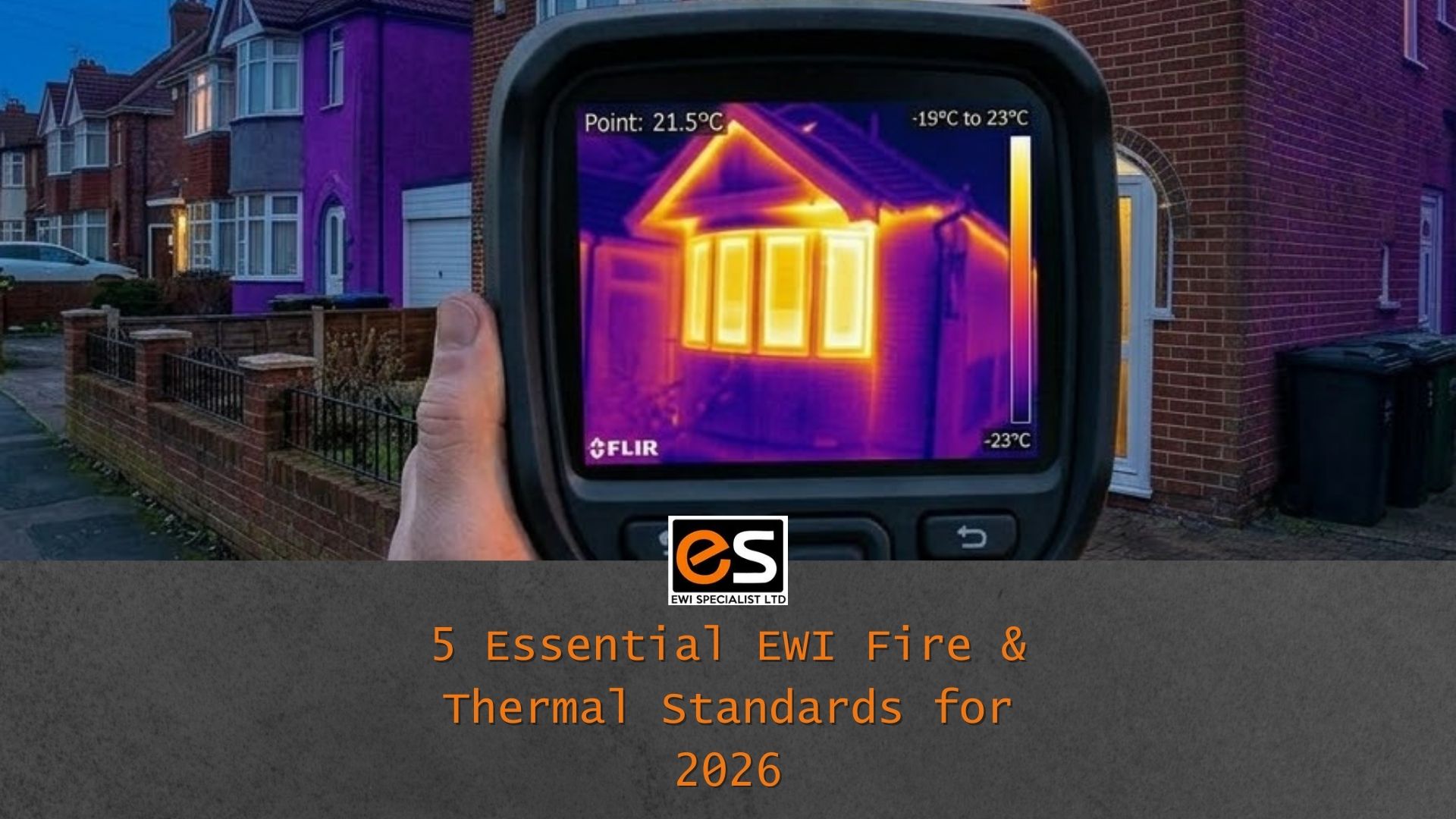
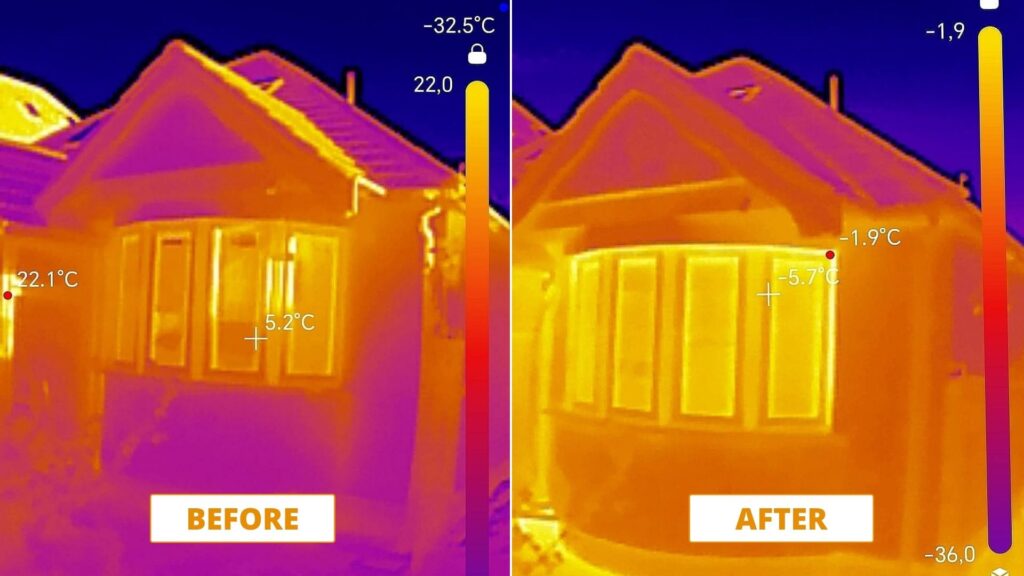
In the 2026 retrofit market, thermal imaging has transitioned from an optional tool to a mandatory component of the PAS 2035:2023 whole-house assessment process. A thermal camera detects infrared radiation, identifying exactly where a building is losing heat. At EWI Specialist, we provide a comprehensive report for our clients featuring detailed thermographic analysis.
Thermographic analysis identifies critical failure points that undermine the 0.18 W/m²K wall U-value targets required by 2026 standards:
- Thermal Bridges: Identifying localised areas where thermal resistance is significantly lower than the surrounding fabric.
- Junction Anomalies: Clearly identifying cold spots around windows, lintels, and corners.
- Workmanship Analysis: Detecting “shoddy workmanship”, such as gaps between insulation boards filled with basecoat instead of appropriate insulation material, which creates linear thermal bridges.
- Moisture Mapping: Identifying areas of dampness or moisture accumulation. Because water has high thermal conductivity, it appears as a distinct thermal anomaly, providing an early warning system for penetrating or rising damp.
For accurate results, professional surveys are conducted when there is a significant temperature differential (ΔT) of at least 10°C to 15°C between the interior and exterior.
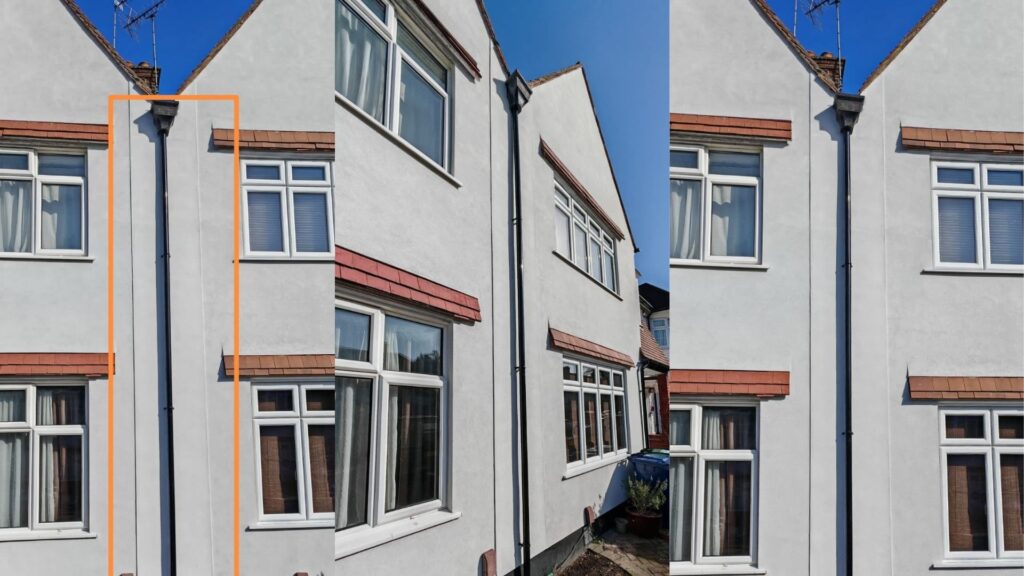
3. Mandatory 20cm Rockwool Fire Breaks
While thermal performance drives energy savings, fire safety is the regulatory hurdle that determines the legality and marketability of a property in 2026. The most critical application in the domestic EWI sector involves the protection of property boundaries, as highlighted in the Fire Safety Act 2021.
Government regulations now strictly stipulate that a fire break consisting of a minimum of 20cm (200mm) of Rockwool must be placed between the walls shared with a neighbour (the party wall). Rockwool is the industry standard because it has a Euroclass A1 non-combustible classification. Unlike expanded polystyrene (EPS), Rockwool does not melt or emit toxic smoke and can withstand temperatures exceeding 1000°C.
Why this is a “Must-Have” Procedure:
- Selling Your Home: You cannot sell your home without this. Surveyors will flag the lack of a fire break, making the property unmortgageable.
- Guarantees: Systems will not be granted a warranty or guarantee without proof of fire break installation.
- Developer Sign-off: For any building project or renovation in a developer capacity, the building will simply not be accepted by inspectors without it.
4. Workmanship Verification and Quality Assurance
A successful EWI project requires more than high-performance materials; it demands a technical design where fire protection and thermal efficiency are integrated. Under PAS 2035:2023 standards, workmanship is strictly monitored to prevent system failure.
Professional installers must follow specific technical protocols:
- Structural Checks: Existing walls must undergo rigorous checks for cracks and loose masonry to ensure a secure base.
- Surface Preparation: Substrates must be sound and clean, with moisture levels below 20% before any insulation boards are applied.
- Lamella Fire Breaks: Horizontal fire breaks, typically 200mm wide, are installed with fibres at right angles to the wall to prevent the “chimney effect” fire spread within systems using combustible insulants like EPS.
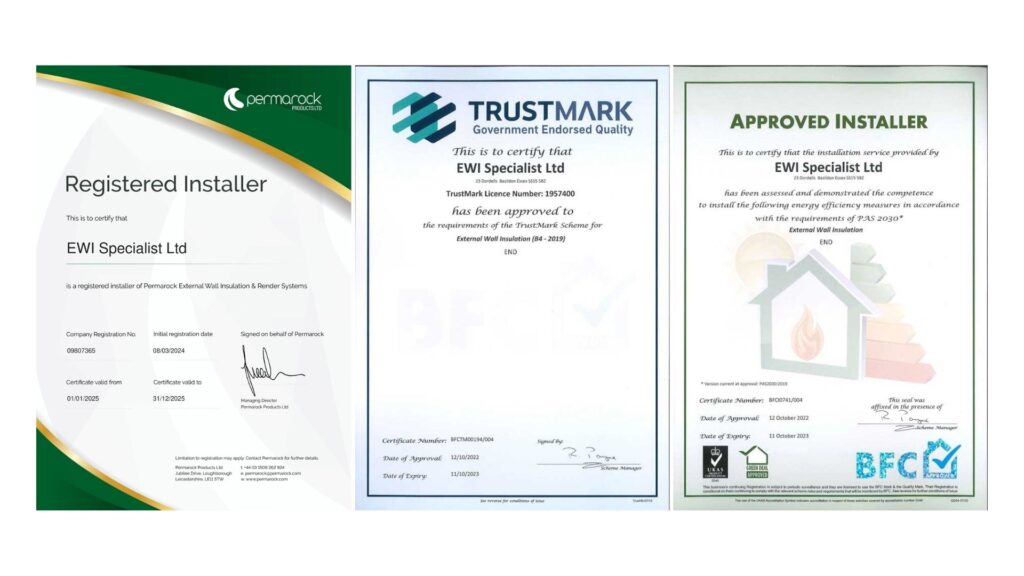
EWI Specialist is a TrustMark-registered company and PAS 2030-certified EWI installer, ensuring your project adheres to these rigorous quality and moisture-control standards.
5. Mortgageability, Legal Compliance, and Awaab’s Law
The presence or absence of a compliant fire break and a comprehensive thermal report has immediate financial and legal consequences for homeowners and landlords.
- The Mortgage Market: Lenders now require full assurance that an EWI system is safe and efficient. A house cannot be sold if a specialist surveyor identifies the lack of required fire breaks.
- Awaab’s Law: Mandates that landlords must investigate significant damp and mould within strict timeframes, following the Social Housing (Regulation) Act 2023.
- The Decent Homes Standard: The government’s updated Decent Homes Standard mandates that all homes must be free of Category 1 hazards and provide thermal comfort.
External Wall Insulation is the primary mechanism for meeting these targets, and thermal imaging is the only non-invasive way to prove these standards are being met.
Take the First Step Toward a Zero-Carbon Home Today
Applying these 5 Essential EWI Fire & Thermal Standards for 2026 is the most effective way to shield your property from rising energy costs and strict new building regulations.
Don’t let your property fall behind the standard.
- Get Your Free, No-Obligation Retrofit Quote – Let our experts design your EWI system.
- Use Our EWI Cost Calculator – Get an instant estimate per m² for your project.
- Contact EWI Specialist – For certified expertise to hit the 2026 benchmarks with total peace of mind.